
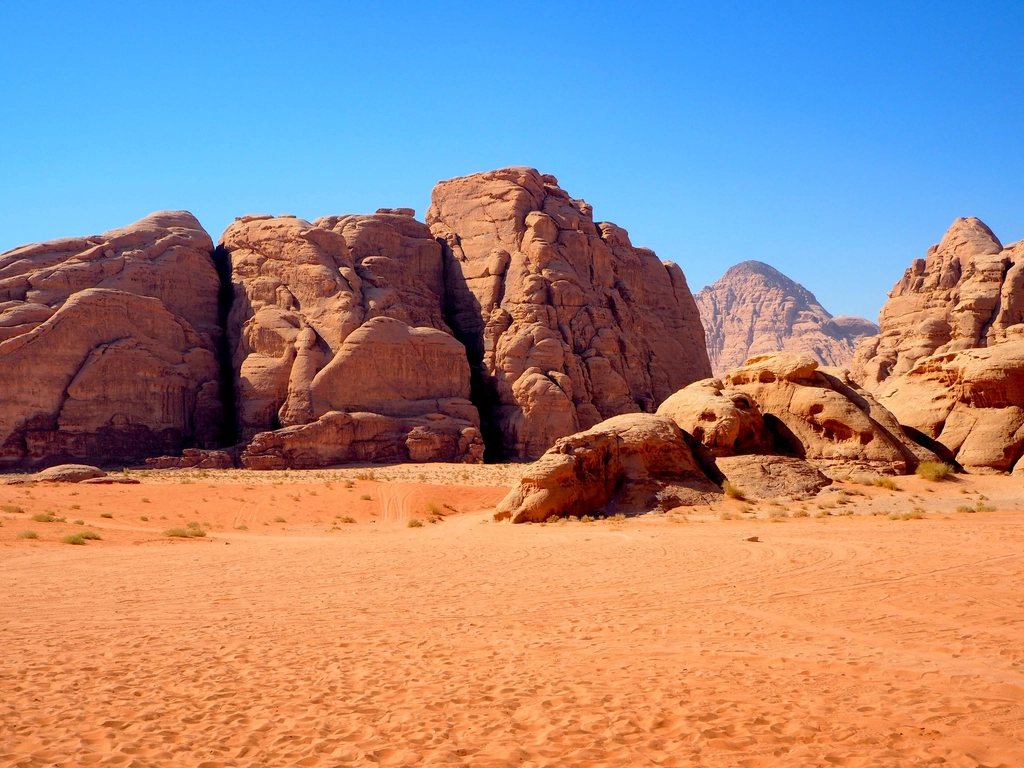
Most visitors see Wadi Rum from the back of a pickup truck, bouncing between the famous sights in a cloud of dust. That is a fine way to get a sense of scale, but it tells you almost nothing about the place. Walk instead, even for a single day, and the desert changes register: you notice the wind-carved ripples in the sand, the tracks of a fox, the way a canyon a few metres wide keeps its shade until noon, and the silence that settles the moment the last vehicle disappears. The protected area covers about 720 square kilometres of sandstone and granite in the far south of Jordan, and it has been on the UNESCO World Heritage list since 2011 for both its landscape and the thousands of rock inscriptions left by people who crossed it over the last 12,000 years. It is also home to the country’s highest summit, Jebel Umm ad Dami, at 1,854 m.
Reading the landscape
Wadi Rum sits at around 950 m above sea level at the village, on a floor of pink and red sand from which the mountains rise almost vertically. The lower parts of the massifs are granite, dark and rounded; the upper parts are sandstone, layered in ochre, red and cream, weathered into domes, fins and honeycombed walls. The two rocks erode at different rates, which is why the mountains have such sharp bases and such convoluted tops. The big valleys, Wadi Rum itself and Wadi Umm Ishrin to its east, run roughly north to south between the massifs of Jebel Rum (1,734 m) and Jebel Umm Ishrin, and most day walks start from the village and follow, cross or cut through these valleys.
Walking here is easy underfoot, on firm sand or slabs, but distances are deceptive: a mountain that looks half an hour away is more often two, and there is no shade between the massifs. The canyons are the exception, and the reason to walk rather than drive.
Jebel Umm ad Dami: Jordan’s highest point
Umm ad Dami stands on the southern edge of the protected area, about 30 km south of the village and almost on the Saudi border. It is not a technical peak. From the point where vehicles stop, at roughly 1,400 m, a clear path zigzags up the northern side over broken sandstone and scree, gaining around 450 m in an hour and a half to two hours. There are one or two short scrambles where hands are useful, but nothing exposed. The summit is marked by a cairn and a flag, and on a clear day the view runs south over Saudi Arabia, west to the Red Sea beyond the mountains of Aqaba, and north across the whole of Rum in a jumble of pink blocks.
Because of the distance from the village, the climb is usually combined with a full-day vehicle tour or a night camped in the south of the reserve. We would recommend the latter. Starting the ascent at first light means cool air and long shadows on the rock, and you are back on the sand before the heat sets in. A guide is required for the border area, and you should carry a passport, as there is a military post on the approach. The descent by the same route takes about an hour.
The canyons: Khazali, Barrah, Rakabat and Abu Khashaba
Khazali canyon is the short one, a slot in the western face of Jebel Khazali that narrows to a metre or so within 150 m of the entrance. It is famous for its petroglyphs: engravings of ibex, ostriches and human figures, some of them Nabataean, alongside Thamudic and Kufic inscriptions. Most groups walk in as far as the first pool and turn around; with a scramble you can push further, but the canyon closes down and the rock is polished.
Barrah canyon is the long one, about 5 km from end to end, running between the Barrah massif and Jebel Abu Judaidah in the south-east of the area. It is broad rather than narrow, a sand-floored corridor between 200 m walls, and it takes two to three hours at a walking pace. A vehicle usually drops you at one end and collects you at the other. It is one of the few places in Rum where you can walk for an hour without seeing a track.
Rakabat canyon is the adventurous option: a route through the heart of Jebel Umm Ishrin that links Wadi Rum with Wadi Umm Ishrin on the far side. It is a canyon in name only; in practice it is a sequence of gullies, slabs and short chimneys that requires scrambling, a head for heights and, unless you have done it before, a guide who knows the way, because the exit is not obvious. Allow three to four hours for the traverse. Abu Khashaba, further south, is gentler: a 3 km walk between rising sandstone walls that opens into a wide sand plain, and a good choice for a first afternoon.
Seasons and heat
Wadi Rum is a walk from October to April. The best months are March and April, when the sand is still cool in the mornings and the occasional rain brings a haze of green to the valley floors, and October and November, when the summer heat has broken. Winter days are pleasant at 15 to 20 C, but nights are cold, often close to freezing, and it does snow every few years. From May to September afternoon temperatures pass 40 C and the sand radiates heat well into the evening; walking is confined to dawn and dusk, and the canyons become very welcome.
Dehydration is the practical risk. Plan on 4 litres per person for a day walk, more for Umm ad Dami, and drink before you feel thirsty; the air is so dry that sweat evaporates instantly.
Practical notes
- Entry to the protected area is through a visitor centre at the northern edge, where a per-person fee is collected; guides and drivers are all local and must be licensed.
- There is no waymarking anywhere. Off-road navigation is by landmarks and experience, which is why even independent walkers usually hire a local for the longer routes.
- Camping is permitted at established Bedouin camps and, with a guide, in the open desert; leave nothing behind, including toilet paper, which does not decompose in the dry sand.
- Mobile coverage is patchy beyond the first few kilometres from the village.
- The nearest town of any size is Aqaba, about 70 km away, with a hospital.
Why walk here
We have walked in a good number of deserts, and Rum remains our favourite for the simple reason that its scale is human. The mountains are close enough to reach on foot, the canyons short enough to explore between breakfast and lunch, and the sand firm enough to walk on without exhaustion. Combine a day of canyons with a dawn ascent of Umm ad Dami and a night under a sky with no light pollution for a hundred kilometres, and you have one of the finest short desert itineraries in the Middle East.