
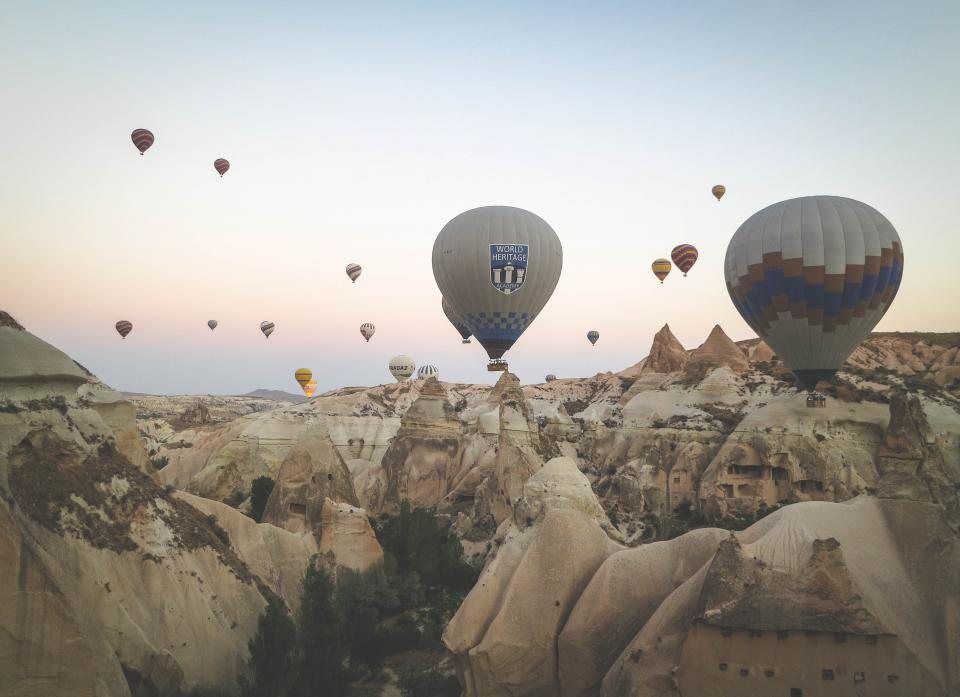
Cappadocia is usually photographed from a balloon. From above, the valleys around Goreme look like a folded pink cloth, and the famous fairy chimneys are reduced to pins. From the valley floor the proportions reverse: the chimneys are twenty and thirty metres high, the walls of soft rock lean over the path, and every second cliff has a doorway cut into it, leading to a chapel, a dovecote or a house abandoned within living memory. This is walking country of an unusual kind, with short distances, modest elevation and an extraordinary density of things to see. We spent a week here on foot and did not reach the end of the valleys we wanted to explore. Three of them, Rose, Red and Ihlara, are the ones we would send anyone to first.
How the landscape was made
The whole region sits on a plateau at 1,000 to 1,300 m, between three volcanoes: Erciyes, at 3,917 m the highest peak in central Anatolia, Hasan Dag to the south-west and the smaller Gullu Dag. Eruptions over millions of years covered the plateau with volcanic ash that compacted into tuff, a rock soft enough to carve with hand tools, capped in places by harder lava and basalt. Rain and wind stripped the tuff away wherever it was unprotected and left it standing wherever a harder cap survived, which is how the chimneys, cones and mushroom shapes were formed. People began digging into the rock at least 3,000 years ago, and by the Byzantine period the valleys were full of churches, monasteries and whole underground villages. The Goreme Open Air Museum, listed by UNESCO in 1985 along with the surrounding landscape, is the concentrated version, but the same churches exist, free and unvisited, all over the valleys.
Rose Valley and Red Valley
Rose Valley, Gullu Dere in Turkish, and Red Valley, Kizil Cukur, run side by side between Goreme and the village of Cavusin, and most people walk them as a single loop of 6 to 8 km, taking three to four hours with stops. The names come from the colour of the tuff, which shifts from cream to pink to brick red as the iron content changes, and which glows in the last hour before sunset. The path enters from the road between Goreme and Cavusin, follows a dry stream bed between vineyards and apricot trees, and gradually narrows between fluted walls that rise to 50 m and more.
The churches are the reason to slow down. The Column Church, Direkli Kilise, has its columns carved from the living rock, and the Church of the Cross, Hacli Kilise, has a huge red cross on its ceiling and frescoes that have survived a thousand years of damp and pigeons. Look for small openings above head height with worn steps leading to them; a headtorch helps. The upper part of the loop climbs onto a ridge with a view over both valleys and towards the flat top of Aktepe, and then descends steeply to Cavusin, an old village whose rock-cut houses were evacuated after a landslide in the 1960s and now form a cliff of empty rooms above the new village. From Cavusin a road walk or a dolmus takes you back to Goreme.
Ihlara: the gorge
Ihlara is different in scale and character, and it is 80 km south-west of Goreme, an hour and a half by car near the town of Aksaray. The Melendiz river has cut a gorge 14 km long and 100 to 150 m deep through the tuff, and the result is a green, shaded ribbon at the bottom of a brown plateau: poplars, willows, frogs, and a running stream in a region where water is otherwise scarce. The walking route follows the river from the village of Ihlara to the village of Selime, passing the hamlet of Belisirma roughly halfway, where a cluster of restaurants serves trout at tables set in the water.
The full length takes four to five hours at an easy pace. There is an entrance fee, collected at the main stairway near Ihlara village where about 380 steps descend into the gorge, and at the other access points. Along the way there are more than a hundred rock churches, of which a dozen are signposted and open; the Church under the Tree, Agacalti Kilise, and the Snake Church, Yilanli Kilise, with its lurid frescoes of punishments in the afterlife, are the best known. At Selime the gorge opens out below the Selime Cathedral, a monastery complex hollowed into a cliff of cones and chimneys that is larger and stranger than anything in Goreme. Most walkers stop at Belisirma, which is a mistake; the second half is quieter and the finale at Selime is worth the extra two hours.
Other valleys worth a day
Pigeon Valley, Guvercinlik, links Goreme and the hilltop village of Uchisar in 4 km and is named for the thousands of dovecotes cut into its walls. Love Valley, north of Goreme, has the tallest and most suggestive chimneys. Pasabag, near Zelve, has the mushroom-capped columns that appear on the postcards, and the Zelve open-air museum next to it is a whole village of rock-cut streets that was inhabited until 1952. Meskendir and Zemi valleys are quieter alternatives to Rose Valley with similar rock and fewer walkers. None of these requires more than half a day.
Seasons and practicalities
- Spring, from mid-April to early June, and autumn, from September to early November, are the best seasons: mild days of 15 to 25 C, cold nights, and clear skies for the balloons.
- Summer is hot and dry, 30 to 35 C, but not unbearable at this altitude; walk early and rest in the shade of the gorges.
- Winter brings snow, often for weeks, and the valleys are beautiful and empty, but paths become slippery on frozen tuff.
- The valley walks are unwaymarked or lightly marked; a downloaded map and a bit of common sense are enough, since you are rarely more than 2 km from a road.
- Carry water in the Goreme valleys; there are no springs. Ihlara has the river and cafes.
- Tuff crumbles: stay off the edges of the ridges and do not climb into churches by routes that show no wear.
Why it deserves your boots
Cappadocia is easy walking by the standards of this magazine, with no summits, no altitude and no long carries. What it offers is concentration: more geology, art and human history per kilometre than anywhere else we know in the Middle East. Give it four days, split between the Goreme valleys and Ihlara, walk in the early morning when the balloons are up and the paths are empty, and save the Red Valley ridge for the last hour of daylight.