
The Sinai Peninsula is a triangle of desert between Africa and Asia, and for most travellers it is a coastline: reefs, resorts and the Gulf of Aqaba. Inland, however, lies one of the great mountain deserts of the world, a knot of red granite peaks rising above 2,600 m, cut by wadis with springs and walled gardens, and inhabited by Bedouin tribes whose paths across it are far older than any map. Since 2015 those paths have been linked into the Sinai Trail, the first long-distance hiking route in Egypt and a project owned and run entirely by the tribes themselves. At its heart stands Jebel Musa, Mount Sinai, 2,285 m, the mountain identified in the Abrahamic traditions with the giving of the law, and one of the most walked-at-night summits on earth. We climbed it for dawn at the end of a week on the trail and, jaded as we were by the reputation, found it extraordinary.
The trail in outline
The Sinai Trail opened as a 220 km, twelve-day route from the coast at Ras Shaitan, north of Nuweiba on the Gulf of Aqaba, to the summit of Mount Sinai, crossing the lands of three tribes. In 2018 it was extended into a circuit of about 550 km that crosses the territories of eight tribes and takes six to seven weeks to walk in full. Very few people do that. The trail is designed to be walked in stages, with a different tribe guiding each section, and most visitors take one of the classic twelve-day traverses or a shorter three to five-day loop out of the town of St Catherine.
The landscape changes dramatically along the way. The coastal sections are sandstone country: flat wadis with occasional acacias, coloured canyons, and the White Canyon and the Coloured Canyon near Nuweiba. Further west the sandstone gives way to the granite of the high mountains, a chaos of peaks, domes and boulders around St Catherine, where the trail climbs above 2,000 m and springs feed orchards of almond, apricot and olive behind stone walls. Jebel Katherina, at 2,629 m the highest mountain in Egypt, lies just south of Mount Sinai and is climbed on several of the loops.
Walking with the Bedouin
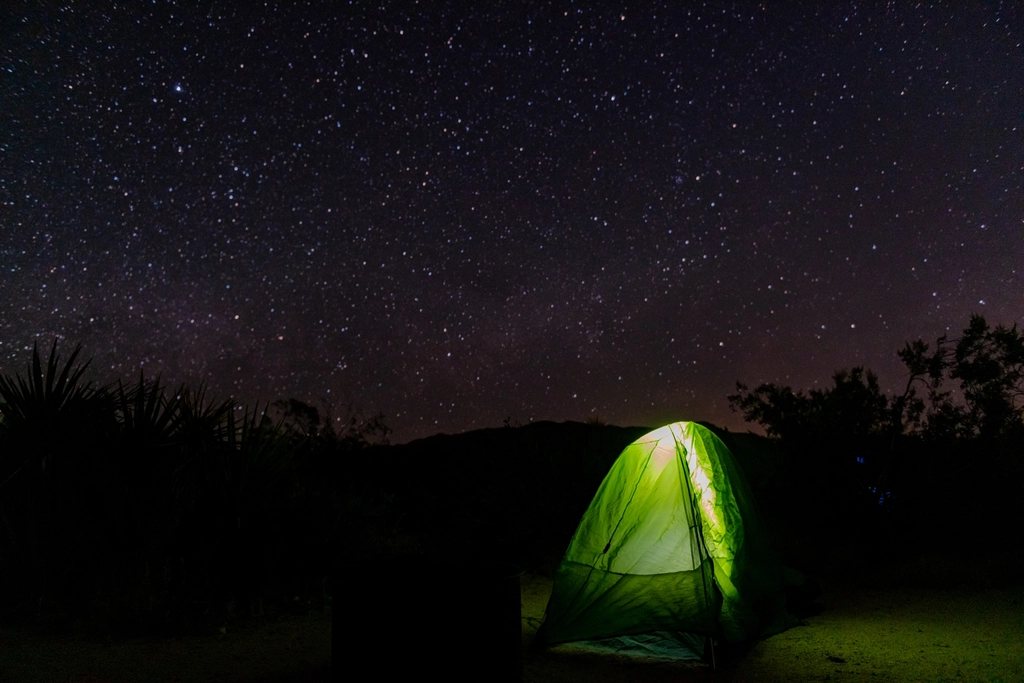
The rule of the trail is that you walk with a Bedouin guide from the tribe whose land you are crossing. This is not a formality. The route is not waymarked, water sources are known rather than signposted, and the whole point is that the trail is a livelihood for the communities along it. Camels carry the food and water, a cook travels with the group, and nights are spent in the open on a blanket beside a fire, or in a garden enclosure in the mountains. Around St Catherine the Jebeleya tribe has guided visitors for centuries; their gardens in the high wadis, with stone huts and cold pools, are some of the loveliest places to sleep we know.
The style of walking is unhurried: an early start, a long break through the heat of the day, tea at every stop, and a late afternoon push to the camp. Daily distances run from 12 to 22 km, and there is little of the summit-bagging urgency of the Alps. It takes a day or two to adjust and then it is hard to imagine walking any other way.
Mount Sinai at dawn
The mountain rises directly above St Catherine’s Monastery, the sixth-century fortress-church at about 1,550 m at the head of a valley, and there are two ways up. The camel path, Siket El Bashait, is about 7 km of broad, gently graded track that switchbacks up the northern flank, passing a few tea huts, to a saddle called Elijah’s Basin, where a cypress tree and a small chapel stand in a hollow below the summit. From there 750 rock steps lead to the top. The direct route is the Steps of Repentance, about 3,750 stone steps laid by monks up a steep gully from the monastery; it is shorter, harder on the knees, and beautiful in the first light. Most people go up by the camel path in the dark and come down by the steps.
The dawn ascent starts between 2 and 3 in the morning, depending on the season, and takes two to three hours. It is cold. Even in April there is often frost at Elijah’s Basin, and in winter the summit can be below freezing with snow on the steps; a down jacket, hat and gloves are not optional. The summit holds a small chapel and a mosque side by side and, on a busy morning, several hundred people wrapped in hired blankets, so this is not a wilderness experience. But when the sun comes up over the Gulf of Aqaba and the whole range turns from grey to red, peak after peak in every direction, the crowd falls silent, and the mountain earns its reputation. Descend by the steps as the light improves and you will have the gully largely to yourself.
Seasons and conditions
The Sinai is a cool-season destination. October to April is the walking window, with daytime highs of 15 to 25 C in the mountains and warmer conditions on the coast. Nights are cold throughout, and from December to February the high peaks see snow, sometimes enough to close the steps for a day or two. Summer, from June to September, brings 40 C to the wadis and is not recommended for anything longer than the dawn climb. Spring and autumn are ideal, and March to April adds flowering almond trees in the mountain gardens.
Practicalities
- A guide is required for all walks in the St Catherine Protectorate, including Mount Sinai; guides are arranged in the town and are always local Bedouin.
- The protectorate charges a small entry fee, and the monastery has its own limited opening hours in the morning; check them if you want to visit after the climb.
- St Catherine town is reached by road from Sharm el-Sheikh, Dahab or Nuweiba in two to three hours, through several police checkpoints; carry your passport.
- Bring a headtorch with fresh batteries, warm layers, at least 2 litres of water for the dawn climb, and cash for tea huts and camel hire if needed.
- Dress modestly, ask before photographing people, and expect the pace of the day to be set by your guide.
Why it matters
The Sinai Trail is more than a route. It is an attempt, so far a successful one, to give the mountain tribes of the peninsula an economic reason to keep their paths, their gardens and their knowledge alive, at a time when tourism has drained towards the coast. Walking it, even for a few days, supports that directly. Combine a short loop in the high mountains with the dawn on Mount Sinai and you will come away with an understanding of this desert that no beach resort can provide.